


THE first greeting traditionally offered in Japan on New Year’s Day is Akemashite, o-medeto gozaimasu.
So, akemashite, y’all! And Happy New Year!
Posted by ampontan on Tuesday, January 1, 2013
THE first greeting traditionally offered in Japan on New Year’s Day is Akemashite, o-medeto gozaimasu.
So, akemashite, y’all! And Happy New Year!
Posted in Holidays | Tagged: Japan, New Year's | 22 Comments »
Posted by ampontan on Monday, December 31, 2012

Nakamura Mari, who has been performing as a busker (with an electric keyboard) in front of train stations until the last train of the day. She’s sold 80,000 CDs in four years. A group of 15,000 fans provided her enough support to get her a solo gig at Budokan in Tokyo. The performance here is at Shibuya Station.
Posted in Music, Photographs and videos | Tagged: Japan, Tokyo | 2 Comments »
Posted by ampontan on Monday, December 31, 2012
一言居士
– A person who has something to say about everything
A certain media outlet asked me to review some book about the South Korean presidential election. When I asked them if I could choose the book to review, they told me to choose whichever book I liked from my perspective. When I asked them if they would accept a book with a slanted viewpoint, they said that would be fine. I accepted the job on those terms. But then they told me I couldn’t use the book I selected.
– Kimura Kan, Kobe University professor
Posted in Mass media, Quotations, South Korea | Tagged: Japan, South Korea | Leave a Comment »
Posted by ampontan on Sunday, December 30, 2012

Floats at the Sakurayama Hachiman-gu fall festival in Toyama, Gifu.
Posted in Festivals, Photographs and videos | Tagged: Gifu, Japan, Shinto | 5 Comments »
Posted by ampontan on Sunday, December 30, 2012
一言居士
– A person who has something to say about everything
South Korean historical scholar Cheong Jae-jeong’s statement that Takeshima is the same as Mt. Fuji for the South Korean people is absurd. The intellectuals and the mass media give their full support to the government’s propaganda that small islets which had no meaning for them 60 years ago are now the symbol of the race. Cheong is affiliated with the Korean Northeast Asian History Foundation, which is a propaganda organ. It would be pointless to conduct joint historical research with them.
– The Tweeter known as Aceface
Posted in History, International relations, South Korea | Tagged: Japan, Takeshima | 1 Comment »
Posted by ampontan on Saturday, December 29, 2012

The 21st Kagura Festival in Aso, Kumamoto. The festival brings together different styles of Shinto kagura dance from around the country. This year 10 groups participated.
Posted in Arts, Photographs and videos, Traditions, Uncategorized | Tagged: Japan, Kumamoto, Shinto | Leave a Comment »
Posted by ampontan on Friday, December 28, 2012

Kukuchi-jo, a (perhaps) Korean-style fortress, now a national historical structure in a national park in Yamaga, Kumamoto. It is not known when it was built, but the name first appears in written records in 698. Here’s the Japanese-language website.
Posted in History, Military affairs, South Korea | Tagged: Japan, South Korea | 15 Comments »
Posted by ampontan on Friday, December 28, 2012
一言居士
– A person who has something to say about everything
Whenever the Emperor is brought up, the Japanese dispense with reason and lose their capacity for judgment. The Japan that existed before the Second World War again shows its face. It’s the same with the Japanese government and their attitude that they can’t let anyone say one word about the Emperor.
– A Choson Ilbo editorial
Posted in Imperial family, Quotations, South Korea | Tagged: Japan | 6 Comments »
Posted by ampontan on Friday, December 28, 2012
AT what point does one’s reaction to the absurdities of South Korea’s preoccupation with Japan pass from amusement at a diversion that resembles the ramblings of a wild-haired street corner preacher to sadness tinged with dismissive indifference at the frenzied intensity of smallness playing large? This excerpt from an article written by Seon U-jeon that appeared in the Chosun Ilbo — which the newspaper translated into Japanese — comes close to defining that passage for me. It’s titled, What South Korea has but Japan doesn’t.
It’s tempting to answer, “Crazed irrationality about a neighboring country”, but I’ll leave that for you to decide.
*****
There are 290,000 foreign students in China, of which the most, 60,000, are from South Korea.
Japan once sent many students abroad 100 years ago, but it has lost its vitality. This is reflected in the sharp decline in students going abroad, the popularity of Korean pop culture, the strength of Korean corporations, and education.
Today’s South Korea is just like Japan a century ago. From the 19th century to the early 20th century, the number of Japanese going abroad to study reached 24,700. They sent more students overseas than any country in the world. There were 43 students accompanying the Iwakura mission (1871-1873) to visit the Western powers, six of whom were young women. That gives one an idea of their passion for studying abroad at the time. The stunning development of modern Japan resulted from their bringing learning back with them, though many were dismissed overseas as monkeys. They served as a bridge to the Great Powers. It was these students who broke the chains binding Japan during its period of isolation.
The number of Japanese students now in China is fewer than half the number of South Korean students. The number of Japanese students in the United States is just 28% the total of South Korean students. It is not that Japan is a country with nothing to learn from other countries. Even after Japan became a member of the advanced countries, it continued to send many students abroad into the 1980s. The sharp decline in the number of overseas students began when economic growth stalled and society lost its vitality.
Students studying abroad are an accurate reflection of a country’s hopes and the strength of its people. We view Japan’s rightward lurch as the floundering of out-of-control old men, because we now have what Japan had 100 years ago. The passion for Korean pop culture sweeping the world is as resplendent as the Japonism that swept Europe and the United States a century ago. The ability of Korean companies to seize markets is reminiscent of Japanese corporations after the war. Times have changed.
*****
Some observations, though you surely have many of your own.
* I’ve read some of the records of the Iwakura mission, which are still in print. They’re boring and not worth reading in their entirety because they are nothing but hundreds and hundreds of pages of the most basic travelogue. They’re like a postcard expanded into a book. The Meiji-era Japanese were literally visiting a new world beyond their imaginations. Nowadays, Japanese of average means can — and do — hop on a flight to New York after work on Friday to catch a Saturday night concert by a favorite performer and return in time for work Monday morning.
* Mr. Seon might be more accurate in his assessment than he suspects. In this article, Koreans do come off like the Japanese 100 years ago — going abroad to marvel at a new world beyond their imaginations. That says more about Korea, its degree of openness, and its entrapment in the mindset of a previous century than it does about Japan and its vitality.
* What is it exactly that Japanese students need to learn by studying at a Chinese university? Other than getting advanced practice in the Chinese language, very little. And what, for that matter, is it that Japanese students have to learn as undergraduates or masters candidates at the exorbitantly priced cesspools of political correctness that American universities have become?
* Japan sent so many students abroad a century ago because it was so far behind the West and wanted to catch up. Exactly what learning would they be bringing back from China?
* If Japanese universities are so inadequate that education needs to be supplemented by overseas universities, why are so many Chinese and South Koreans coming here to study?
* The only real reason that so many Koreans are studying in China is commercial — that’s where they think the money is. But then Koreans have a long history of fealty to the Chinese imperium.
* The Japonism of a century ago was a result of the admiration for the aesthetics of Japanese art and culture, such as ukiyoe and ceramics. Do Koreans think they have supplanted the Japanese in the West by offering chewing gum pop culture?
I’m glad I won’t be exposed to the internal Korean dialogue when the world forgets about Gagnam Style and they have to pick themselves up off the floor in a daze after the crash of the mother of all sugar highs.
* It always bears repeating: Saying that Japan has lost its vitality is prima facie evidence that the speaker knows next to nothing about today’s Japan.
* And yes, Japan is still the gold standard by which the Koreans judge themselves.
*****
When he was assigned to Japan, the author of this article received the Japan-Korea Cultural Exchange Award as the representative of a Korean newspaper.
*****
Speaking of Korean education, here are some photos of a demonstration earlier this month in front of the Japanese embassy conducted by primary school students and their teachers. Got to start washing those brains early, eh?
Japanese people apologize!

Japanese people, recognize your errors! (That’s a photo of the comfort woman statue on her sign.)
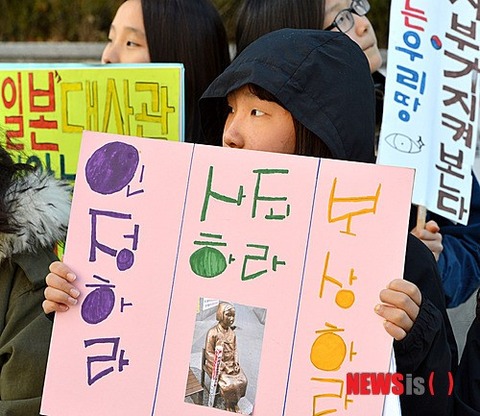
Apologize for the comfort women!

The photo prop on the left is the comfort woman statue and the photo prop on the right is holding a sign saying that Takeshima is our land.

If Korean primary school take their students on field trips such as these, it is a matter of extreme urgency for even more students to study abroad when they reach university age. Even at Chinese universities
Posted in China, Education, History, I couldn't make this up if I tried, International relations, Social trends | 65 Comments »
Posted by ampontan on Thursday, December 27, 2012

Giving young people the experience of harvesting and threshing rice as it was done in the middle ages at a rice paddy in Bungotakada, Oita, which has been designated as an important cultural landscape of the nation. It’s an annual event, and this year 500 people participated.
Posted in Agriculture, Photographs and videos, Traditions | Tagged: Oita, Rice | Leave a Comment »
Posted by ampontan on Thursday, December 27, 2012
一言居士
– A person who has something to say about everything
There has been a lot of discussion in South Korea recently that they’ve succumbed to the “Japanese Disease”. But the vast majority believes they can overcome it if they boost the growth rate. Whenever I ask South Koreans about the lack of manpower due to the aging of society, they say they can overcome their demographic problems by bringing in a large number of people from China and elsewhere. Most people answer, “All we have to do is utilize people from North Korea and China.”
– Suzuoki Takabumi of the Nikkei Shimbun
Posted in Demography, Quotations, South Korea | Leave a Comment »
Posted by ampontan on Thursday, December 27, 2012
MANY Japanese are fascinated by the Edo period, which extended from 1603-1868. Among the many reasons is that was a period of vigorous cultural activity that was distinctively Japanese, as the country had withdrawn from most interaction with the rest of the world. In the words of the Kodansha Encyclopedia, developments during the period “strongly influenced the political organization, social structure, ethical practices, and aesthetic perceptions of modern Japan.”
Author and columnist Tachibana Akira wrote an article published in the Weekly Purieibooi earlier this year whose intent was to keep the interest in the period grounded in reality. The title of his article was, If you want to learn about life in the Edo period, go to a slum in India. Here it is in English.
*****
You sometimes hear people frustrated with the lack of growth in the Japanese economy say they would like to return to the ordered society of the Edo period. They seem to think that life was by far more humane in pre-modern society than today’s free market-based society.
Researchers in the new academic discipline of historical demography are studying past population trends using records of the population registers called shumon aratamecho and ninbetsu aratamecho. What can we learn about daily life in the Edo period studying the movement of people and changes in the population?
The historians have discovered some strange phenomena as a result. While the population increased in most regions during the Edo period, they declined in the (highly populated) Kanto and Kinki regions. These two regions contained the cities of Edo (Tokyo), Osaka, and Kyoto, which had more than one million people each. Why did the population grow in regional areas and fall in the cities?
It’s because living conditions in those cities at the time were foul.
Other than those instances in which their farmland was expanded through reclamation or other projects, all but the eldest sons of farm households went elsewhere to seek work. Most of them left home at age 14-15 to become apprentices. It was common to take up such work as the weavers of Nishin brocade or to become attached to commercial establishments.
The apprentices lived packed into the back rooms under the roof in commercial establishments. They became particularly susceptible to infectious diseases. Extensive harm was unavoidable if there was an outbreak of smallpox or dysentery.
While the infant mortality rate was high during the Edo period, it was not unusual for people in agricultural villages to live into their 60s. In the three largest cities, however, deaths from malnutrition or infectious disease in one’s teens or twenties were a frequent occurrence.
The population of Japan in the ordered society of the Edo period remained constant at roughly 26 million. This was not because of the stability of society, however, but because the population increases in the farming villages were weeded out in the cities. Edo, Kyoto, and Osaka were death traps for the young people who went there to find work.
The poor from outlying regions who came to Edo found employment as construction laborers, peddlers, or menials at commercial establishments. If they were thrown out of work, it is likely they had few options other than begging or prostitution to survive.
If you think about it, their lives must have resembled those of the poor in India or Southeast Asia. Those who can’t survive in Indian agricultural villages often wind up in the slums of Delhi or Mumbai. In impoverished countries, it is not unusual for women to find that prostitution is their only means to live. This gives rise to an immense sex industry that ranges from upscale establishments authorized by the government (police) to illegal street prostitution. It is very similar to the prostitution system of the Edo period that reached its zenith with the Yoshiwara quarter in Edo. (The name Yoshiwara became used for similar districts throughout the country.)
Conditions in impoverished countries are very similar. That poverty also existed in the Edo period, and many people had no choice other than to live in nagaya in the slum districts.
You don’t need a time machine to experience life in the Edo period. All you have to do is go to a South Asian slum.
Afterwords:
Mr. Tachibana’s Japanese-language website has an English title: Stairway to Heaven. It features a photograph of the ladders to heaven painted on the side of a mountain near the sacred Yamdrok Lake in Tibet.
Posted in History | Tagged: Japan, Kyoto, Tokyo | 6 Comments »
Posted by ampontan on Wednesday, December 26, 2012

Twelfth-century warlord Taira no Kiyomori worshipped at the Kamo Shinto shrine in Tatsuno, Hyogo. The shrine recreates in period costume a procession with Kiyomori and his wife Tokiko.
Posted in Photographs and videos, Shrines and Temples, Traditions | Tagged: Japan | Leave a Comment »
Posted by ampontan on Wednesday, December 26, 2012
一言居士
– A person who has something to say about everything
I do not repudiate either the “post-nation state” or regional devolution. It might be that the bright future for mankind is a borderless aggregation of free individuals. But that is a world of self-responsibility requiring extreme self-sufficiency with considerable costs. It is not frivolous behavior that resembles a son having an argument with his father, storming out of the house, and demanding that he keep sending money.
– Baba Masahiro
Posted in Quotations | Tagged: Japan | Leave a Comment »
 AMPONTAN
